This is a short preview of how the Consumer’s mind works and savvy Marketing Practitioners create Marketing Cues to increase Purchase Intention for their products!
Understanding the consumer mind starts with a simple premise:
We didn’t lose our ancestors’ minds!
Even though Humans have developed through evolution, we actually have kept all the previous brains (and minds thereof) that we used in the very far past.
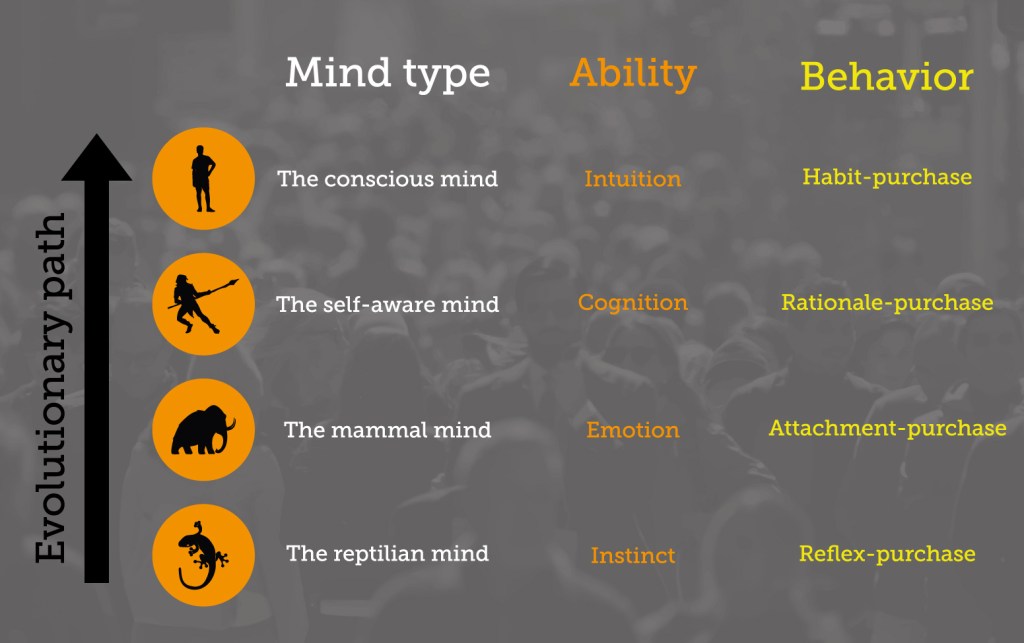
That’s what Consumer Evolution theory teaches us; The human mind is comprised of multiple evolutionary minds. Each is designed for a purpose and we use all of them daily! All that, so we can be highly sophisticated consumers that we are today!
The mental evolution is a survival mechanism – whether to fend of predators or to find nutritious food to prolong lifespan – the mind is pushing the envelope, always on the verge of new discoveries!
That’s why marketers study consumer behavior. We want to be part of your evolution!
I. Instinct – Reflexive Purchase
When the car fuel is low our INSTINCT kicks in and we are on a mini-mission searching for a gas station to refuel. This process is triggered by a small event and it bypasses the conscious mind.
At this level of mental activity, the consumer is faced with a simple need that is not fulfilled. It is usually an essential product to life or a commodity.
example of Instinct Purchases: food, fuel, heat, electricity, coffee, cigarettes, etc.
II. Intuition – Product Attachment
As mammals learned to socialize and use group strategy to survive, we started bonding with other creatures and forming attachment to our close family members, group leaders and attractive individuals. EMOTION capability meant that Humans are able to Attach Value to group members, ourselves and even object that resemble something/someone valuable.
Consumers, too, use Emotions in making Purchase Decisions. In fact, Emotions are one of the most powerful drivers (motivators) of Purchase Intention!
Certain brands, like Apple, have the consumers attached to their products (e.g. iPhone). Through consistent brand marketing and influencing consumer perception of their products, Apple has developed attachments and consumers seem to choose them over the competition because of the Attachment Values.
III. Cognition – Rational Decision Making
The next evolutionary step marked the beginning of the Golden Age of Human kind. As we were the most sophisticated mind alive, we thrived and reproduced in vast numbers!
When Humans became self aware, they have gain a new kind of mind the COGNITIVE mind. With it, we were able to invent the fire, cooking, clothes, tools, farming, warfare and so on.
Consumers decide between products and make rational decisions that lead to purchasing a product.
If you wish to buy a car, usually you would jot down some numbers to figure out your budget, then you’d search for cars you like, then compare them, and finally, call the distributor and try negotiate purchase conditions.
A monkey can’t do that.
Marketers know that consumers may be calculating and often strike them with offers that may help the consumer to choose their product, instead of that of the competition!
IV. Intuition – Forming Buyer’s Habits
Intuition is very much like Machine Learning. The basic workings of INTUITION is simple; it uses all the information stored in our mind (conscious and subconscious) to deliver best possible decisions!
Often confused with Instinct, Intuition is far more superior!
How do our hearts beat? or Lungs breath? There seems to be an Autopilot unit responsible for these actions. The same goes for Intuition, after walking for 20 years of your life, you no longer need to think about walking – You just DO!
Consumers exhibit Intuitive decision-making all the time. When you go to the supermarket to buy food products, you scan quickly the information and you quickly make a decision whether to place it in the Cart or not!
Habit, once developed, cannot be broken or even
changed easily. Think about all the bad
habits you are aware of and
yet you still do it!
Habit Buying allows the Consumer to think about other needs and desires for himself. Habits are often formed by sticking to a single vendor or a brand.
Consumer Habits are what Loyalty Programs are about! Just another way to get the consumer accustomed to using certain products and services.
 FromBuzzToScience